Educator Resources · Path Counting Exploration

Why Do Some Starting Points Create More Paths?

Reaching every ending point is not the same as reaching it in the same number of ways.
01 · Compare two starts02 · Count the routes03 · Discover the whole star
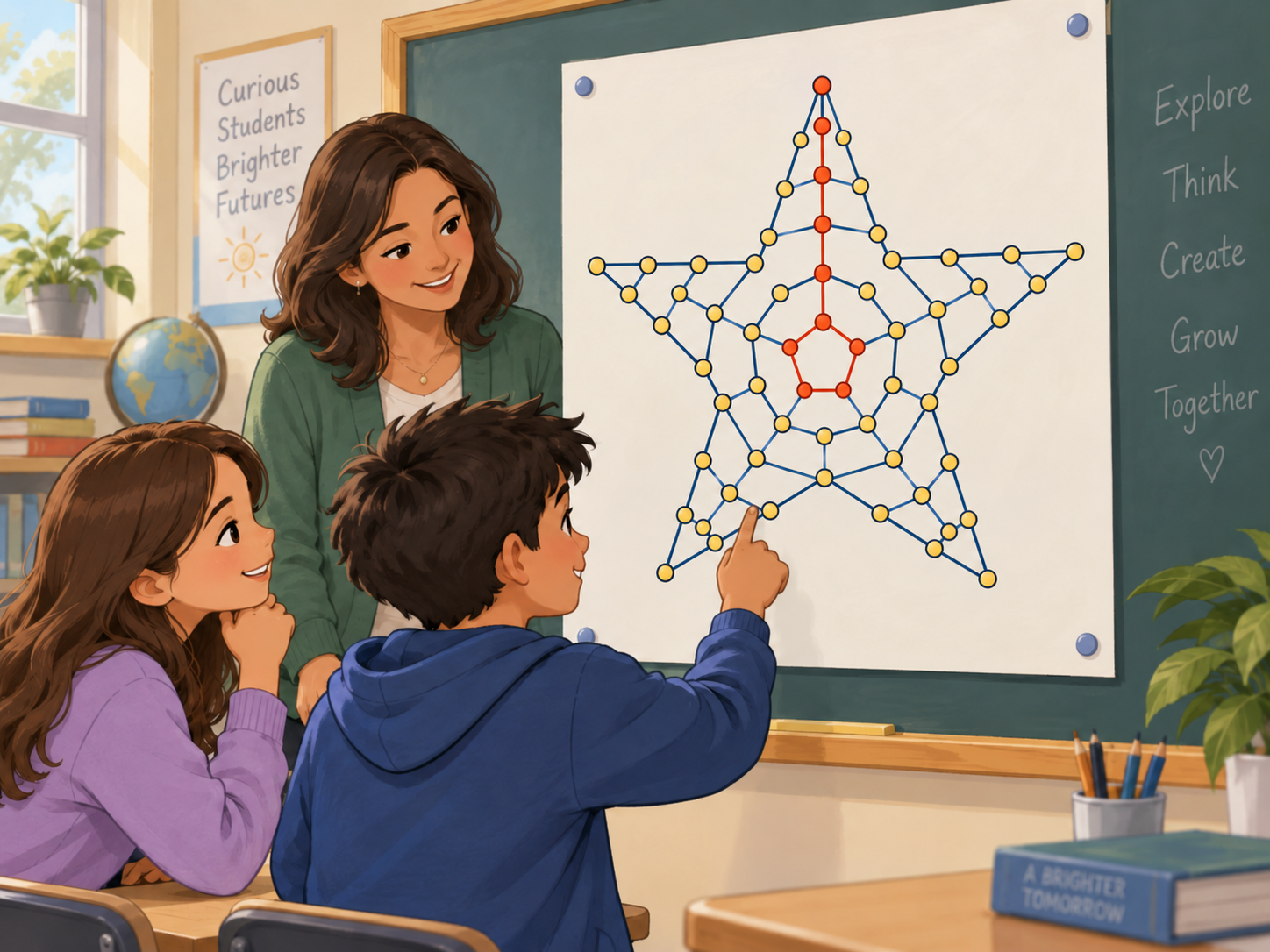
Students exploring path choices in The Great American Star.

Start with a question

Same Endings. Different Possibilities.

Every starting point in one section of The Great American Star can reach every ending point.

If they can all reach the same ending points, why don’t they all produce the same number of paths?

Within one section

Near-edge starting position

5,546,105possible paths through one section

Middle starting position

8,097,610possible paths through one section

Both starting positions can reach every ending point, but the middle starting position can reach them through many more different routes.

Simplified illustration — representative routes only
Selected startValid branches from this start

Near-Edge Start

11 starting points · top

Near-Edge Start on the same simplified lattice Both panels have identical boundaries, rows, 11 starting points and 10 ending points. The second point, near the edge, is selected in gold. Blue branches connect this start to all ten endings. Reaching far-side endings from a near-edge start requires more steps toward that side; the middle allows more varied left/right choices. Representative routes only; this simplified lattice does not reproduce the actual path totals.

Same 10 ending points · bottom

Can reach all 10 ending points, but reaching endings on the far side requires many steps to keep moving in that direction, leaving fewer ways to vary the route.

5,546,105possible paths through one section

Middle Start

11 starting points · top

Middle Start on the same simplified lattice Both panels have identical boundaries, rows, 11 starting points and 10 ending points. The middle point is selected in gold. Blue branches connect this start to all ten endings. Reaching far-side endings from a near-edge start requires more steps toward that side; the middle allows more varied left/right choices. Representative routes only; this simplified lattice does not reproduce the actual path totals.

Same 10 ending points · bottom

Can reach all 10 ending points, with more freedom to vary left/right choices while still arriving at the same endings.

8,097,610possible paths through one section

Same ending points. Different number of routes.

Both starting points can reach all 10 ending points.

The middle can reach them through more different routes because it has more freedom to vary its left/right choices while still arriving at the same endings.

The core idea

Count the Ways to Get There

Reaching an ending point tells us only that at least one route exists. Path counting asks a different question: How many different routes can get there?

A near-edge starting point can reach a far-side ending, but many of its steps must keep moving toward that side, leaving fewer opportunities to vary the route.

A middle starting point has more freedom to vary its left/right choices while still arriving at the same ending point.

Both can reach every ending point, but the middle can reach them through more different paths.

The full-star surprise

One Corner. Two Sections.

Within one section, the corner has 4,194,280 paths and the middle has 8,097,610 paths.

But a physical corner of the complete five-pointed star belongs to two adjoining sections.

Simplified structural illustration — adjoining sections highlighted

Two sections share one inner starting-pentagon corner The gold starting point is a corner of the central starting pentagon, not an outer star tip. Two adjoining mathematical sections extend from the pentagon sides meeting there. Each contributes 4,194,280 paths from that shared corner, totaling 8,388,560 paths in the complete star. AB Sharedstarting point

Section A4,194,280 paths

Section B4,194,280 paths

Corner in complete star

4,194,280+ 4,194,280= 8,388,560

Middle starting position8,097,610 paths

Difference: 290,950 more paths

One physical corner. Two adjoining sections.

4,194,280 × 2 = 8,388,560 paths

In the complete star

Corner · two adjoining sections

8,388,560paths in the complete star

Middle

8,097,610paths in the complete star

The corner now has 290,950 more paths.

8,388,560 − 8,097,610 = 290,950

How can the starting position with the fewest paths in one section end up with more paths than the middle in the complete star?

Pause, predict, discuss

Questions to Ask Students

  • If every starting point can reach every ending point, why can their total path counts still differ?
  • Why does the middle have more possible routes inside one section?
  • What changes when a corner is shared by two sections?
  • Before seeing the numbers, which starting point would you have predicted had the most paths?

Teacher & Student Resources

← Back to Educators